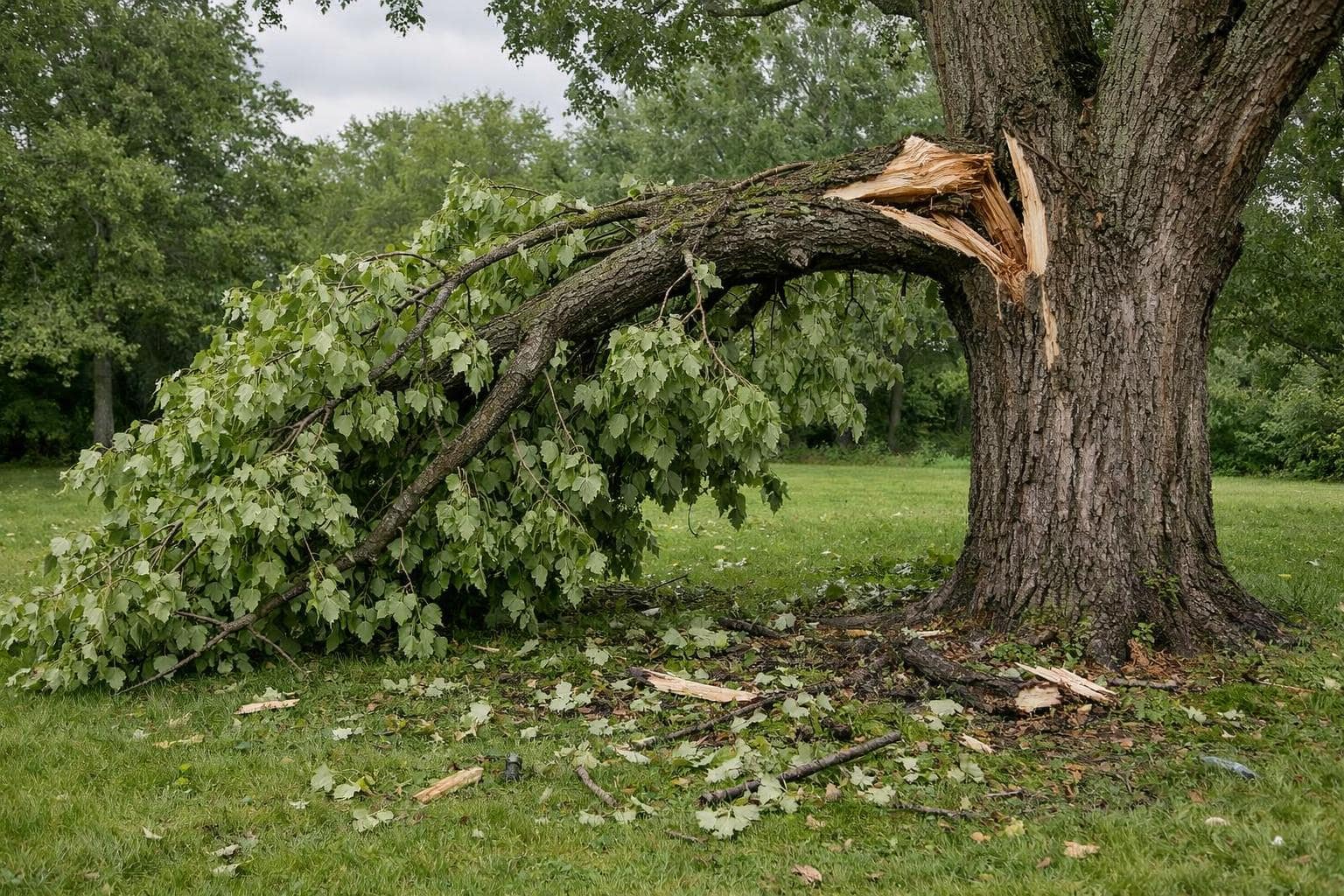
A storm blew through Staten Island last night. There’s a tree leaning against your fence, a massive branch hanging from the canopy, or an entire trunk split down the middle. Maybe the power is out. Your first instinct is to start cleaning up.
Don’t. Not yet.
Staten Island takes more storm-related tree damage than any other borough. A single storm in July 2025 caused over 17,800 power outages on Staten Island alone, compared to about 2,800 in Brooklyn. Trees and power lines were reported down across the borough from Fort Wadsworth to Bay Terrace.
Here’s the right order of operations after a storm, what you can handle yourself, what you absolutely should not touch, and how to avoid scams when everyone on the island needs tree work at the same time.
What to Do After Storm Damage (Step by Step)
Step 1: Stay inside and assess from a safe distance
Survey your property from a window or doorway first. If you see downed power lines, stay at least 30 to 35 feet away. Treat every downed wire as live. Call 911 first, then Con Edison at 1-800-75-CONED. Do not touch anything in contact with a downed wire, including fences, puddles, or tree branches touching the line. If a power line falls on your car while you’re inside, stay in the vehicle and wait for emergency personnel.
Step 2: Report the damage
If the downed tree is a street tree (between the curb and property line), call 311 or report at NYC 311. NYC Parks typically clears fallen street trees within 24 to 72 hours after a storm. If the tree is on private property, it’s your responsibility. If it hit a structure, contact your homeowner’s insurance immediately.
Step 3: Document everything before touching anything
Photograph all damage from multiple angles before any cleanup. This is critical for insurance claims. Most homeowner policies require damage to be reported within 30 to 60 days, but don’t wait.
Step 4: Decide what’s safe and what isn’t
- Small debris and broken branches on the ground: Generally safe to clean up yourself.
- Split branches still attached to the canopy: Professional help needed. Branches under tension can snap back violently.
- Uprooted or leaning trees: Do not approach. These are unstable and can shift without warning.
- Hanging limbs (“widow-makers”): Large broken branches caught in the canopy can fall at any time. Do not walk under them.
Anything beyond small ground debris means calling a professional. Storm-damaged trees are extremely unpredictable.
Step 5: Know when a tree can be saved
Not every storm-damaged tree needs to come down. A professional can determine whether a tree needs full removal or can recover with corrective pruning. Many trees can survive if they retain more than half their crown, have no trunk damage, and have intact root systems.
What Your Insurance Actually Covers (and What It Doesn’t)
This is the part that surprises most people:
- If a tree falls on a covered structure (house, garage, shed, fence), most homeowner’s policies cover both the repair and reasonable tree removal costs.
- If a fallen tree blocks your driveway and prevents access, many policies cover clearing it.
- If a tree falls in your yard but doesn’t hit anything, removal is typically not covered. You pay out of pocket.
- If a neighbor’s tree falls on your property during a storm, your own insurance generally covers your damage. Exception: if the neighbor knew the tree was dead or damaged and did nothing, you may have a liability claim against their policy.
Insurance companies also distinguish between acts of nature and neglect. A tree with documented pre-existing problems that falls during a storm may not get straightforward coverage. This is one reason regular tree inspections matter: they create a record showing you’ve maintained your trees responsibly.
Coverage varies by policy. Check with your insurer for the specifics of your plan.
How to Spot Storm Chaser Scams
After every major storm, unlicensed operators go door-to-door across Staten Island offering tree removal. Here’s what to watch for:
- Unsolicited door-knocking immediately after a storm
- Demands for full payment upfront or cash only
- No written estimate, or refusal to put terms in writing
- No proof of insurance (or insurance that can’t be verified with the carrier)
- No local business presence. Storm chasers travel to disaster areas and leave.
- Pressure to decide immediately
Get multiple written estimates from established local companies. Ask whether debris removal is included. Verify insurance independently by calling the carrier. Never pay the full amount upfront, and don’t make final payment until you’re satisfied with the work.
The Best Defense Is Before the Storm
The USDA Forest Service estimates that 80% of tree damage during natural disasters is associated with a preexisting defect: trunk decay, cavities, weak branch structure, or damaged roots. Most storm damage is preventable.
The work that reduces storm risk: crown thinning to lower wind resistance, structural pruning to build stronger frameworks, clearance trimming to keep limbs away from roofs and power lines, and regular inspections to catch defects before storms exploit them.
FAQ: Storm Damage Tree Removal on Staten Island
A tree fell on my house during a storm. What do I do first?
Make sure everyone is safe and away from the area. Do not try to remove the tree yourself. Call your insurance company, then a professional tree service. Document the damage with photos before anything is moved.
How fast can G&R respond to storm emergencies?
G&R offers 24/7 emergency tree service. During major storm events, call volume is high, but emergencies involving structures, power lines, and safety hazards are prioritized.
A tree fell in my yard but didn’t hit anything. Will insurance cover removal?
Usually no. Homeowner’s insurance typically covers tree removal only when the tree damages a covered structure or blocks access. A tree down in the open yard is usually out-of-pocket. Check your policy to be sure.
Can I remove a storm-damaged tree myself?
Small debris and branches on the ground are generally safe. Anything still attached to the tree, hanging in the canopy, leaning, or near power lines should be handled by a professional. Storm-damaged trees are structurally compromised and unpredictable.
How do I know if a storm-damaged tree can be saved?
Trees that retain more than half their crown, have no major trunk damage, and have intact root systems can often recover with corrective pruning. A professional assessment is the only way to know. G&R can evaluate the tree during a free estimate.
What if a neighbor’s tree fell on my property?
Your own homeowner’s insurance generally covers damage to your property regardless of where the tree came from. If the neighbor knew the tree was hazardous and failed to act, you may have a negligence claim against their policy. Document everything and consult your insurer.
How can I prepare my trees before storm season?
Have mature trees inspected every two to three years. Schedule trimming to reduce wind resistance and remove deadwood. Keep branches clear of your roof, driveway, and power lines. Pre-storm maintenance is almost always cheaper than post-storm cleanup.
24/7 Emergency Tree Service on Staten Island
When a storm hits, G&R Tree Service is available around the clock. We’ve been handling emergency tree removal across Staten Island for over 15 years. We’re fully insured, and owner Glen Gabel is on-site at every job.